RAMPD
Custom workflow system to streamline operations and scale.
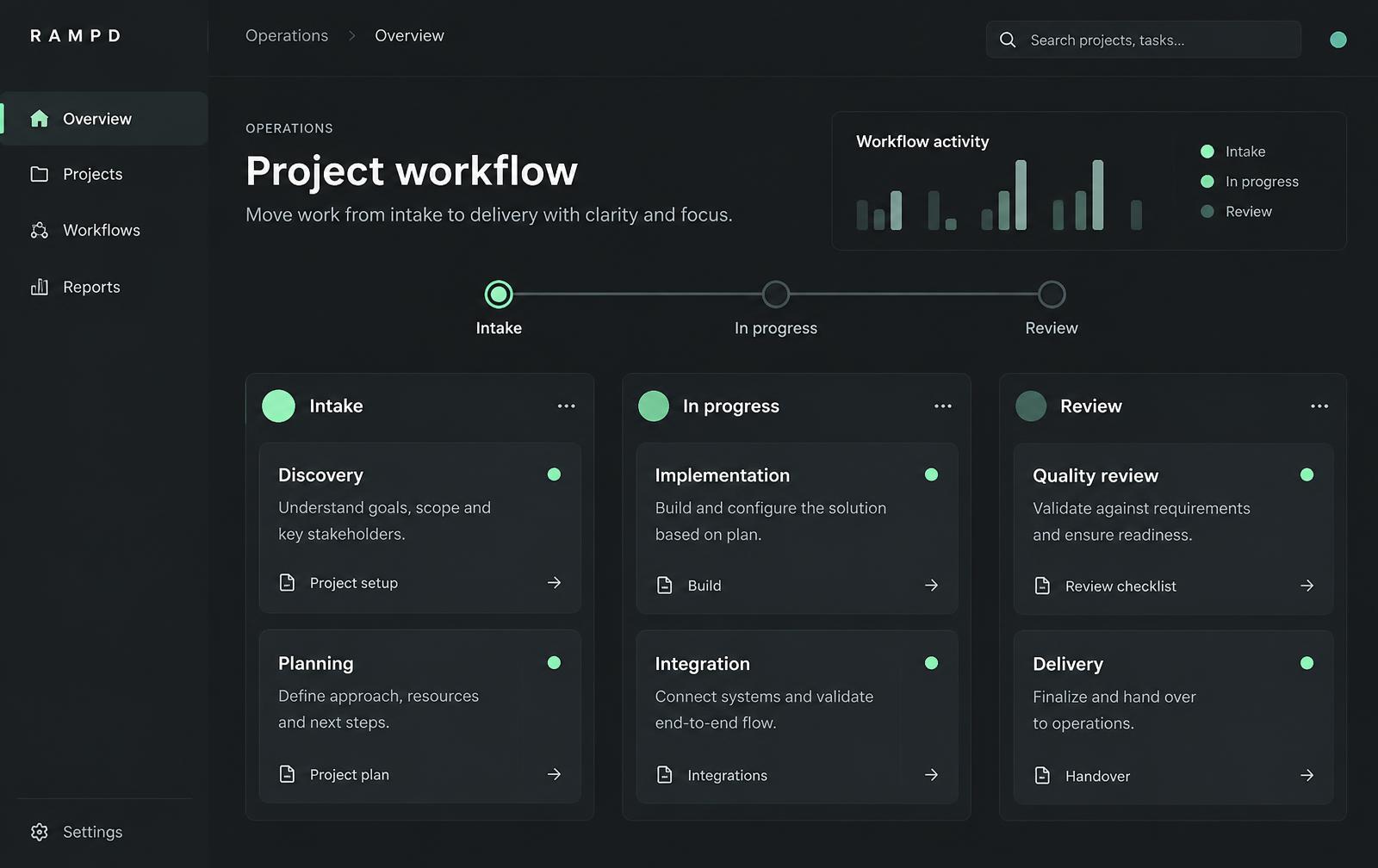
Client Brief
Who they are and what they needed.
- Client
- RAMPD
- Industry
- Operations-intensive services
- Market cap
- To be confirmed
- Market size
- To be confirmed
An operations-led business whose growth was constrained by manual, person-dependent workflows. A custom workflow system was proposed to standardise and scale delivery. Draft entry — details pending confirmation.
Pain Point
Where the friction lived.
Work moved through the business by memory, messages and spreadsheets. Every order followed the same shape but never the same path. Draft assessment — to be validated with the client.
Current bottlenecks
- No single system of record for job status — progress lived in chat threads.
- Handoffs between stages lost context and created rework.
- Leadership visibility relied on asking people instead of reading a dashboard.
Gaps in SOPs
Standard operating procedures existed informally but differed by team and by person, so output quality and turnaround time were inconsistent.
Scalability
The model did not scale: more volume meant proportionally more coordination effort, and adding people added communication overhead faster than capacity.
Feasibility of the solution
Validated against the workflow itself — a large share of steps were repetitive and rule-based, meaning they were automatable once standardised.
Growth rate & savings potential
Savings potential concentrated in reduced coordination time, fewer errors per handoff and faster cycle times. Growth rate estimates to be confirmed.
Eliminating friction, improving ROI
The highest-friction handoffs were mapped first so the workflow system removed the slowest, most error-prone links early — the fastest route to visible ROI.
Solution & Objective
What we proposed and built.
A custom workflow system built around the business's actual delivery path.
- Objective
- Standardise every job into one digital workflow — visible, measurable and repeatable — so scale comes from the system rather than from supervision.
- Technology
- A custom workflow application with stage-gated jobs, role-based views, automated handoffs and a live operational dashboard.
- Strategy
- Standardise the process with the team first, then automate — adopting the team's proven best practice as the system default rather than imposing an external template.
- Go-to-market
- Use operational reliability as the growth story: faster turnaround and consistent quality become the reasons customers stay and refer.
- Funnel analysis
- Mapped intake to delivery to invoicing as one funnel, with each stage instrumented for cycle time and drop-off, so bottlenecks surface in data instead of in escalations.
Projections · Q1 2027
What we're working toward.
Illustrative projections, not measured results or client-validated forecasts. These planning ranges use assumed improvements, not supplied baseline data. Results are expected in Q1 2027.
15–25%
Illustrative projection
Job cycle time reduction
20–30%
Illustrative projection
Handoff error reduction
30–45%
Illustrative projection
Status-chasing effort reduction
Intended outcome
The intended outcome is repeatable delivery: one visible workflow could reduce handoff errors and status-chasing, with clearer context at each stage. The next reporting cycle will measure the actual operational change.
Further improvements
- Add customer-facing status visibility.
- Automate recurring reporting for key accounts.
- Extend the workflow model to new service lines.
More of our work
All case studiesLET'S BUILD TOGETHER
You don't need another disconnected solution.
A quick call to understand your goals and explore how we can help.