Better Payments
A modern payments infrastructure with a scalable digital platform.
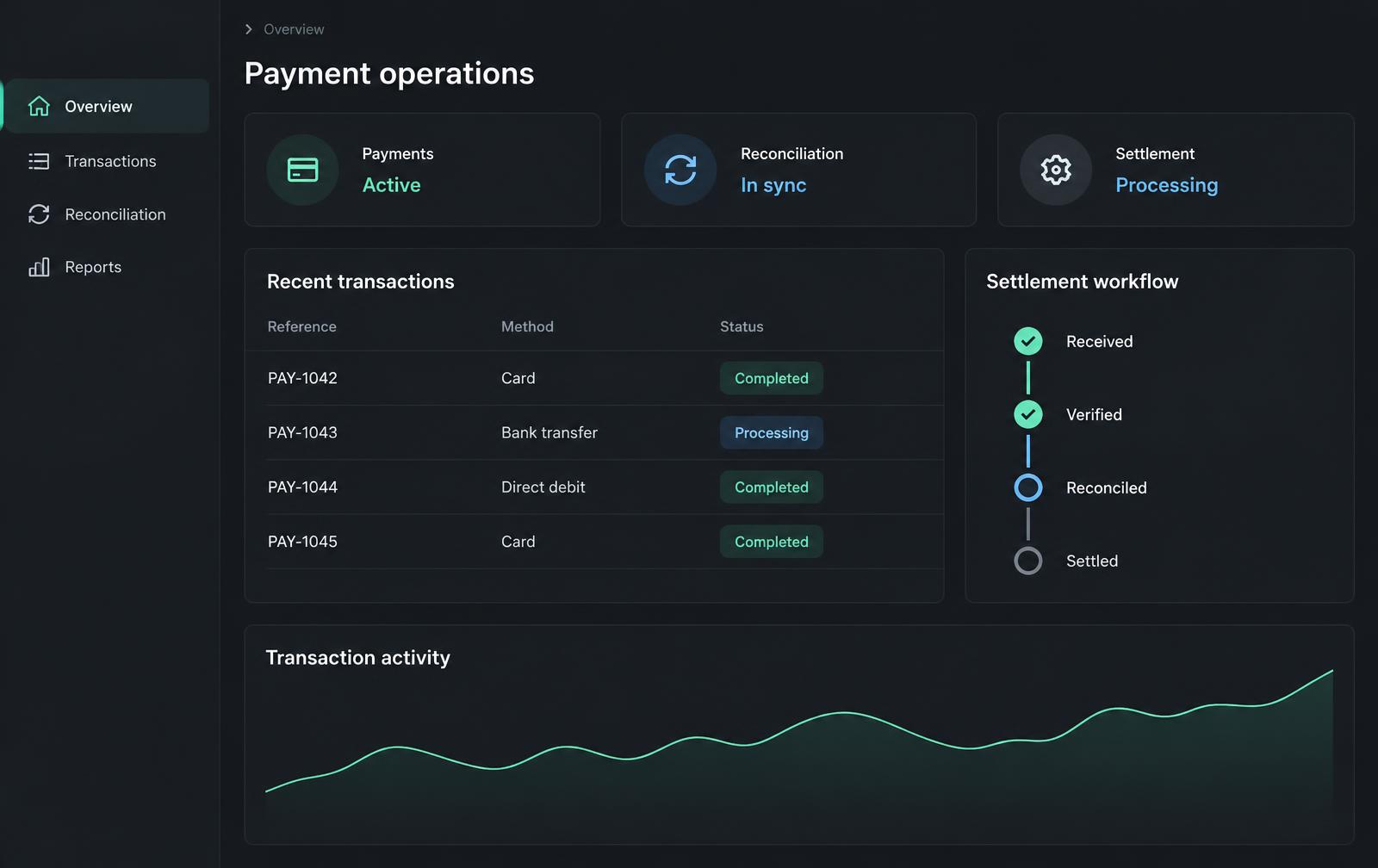
Client Brief
Who they are and what they needed.
- Client
- Better Payments
- Industry
- Fintech — payments infrastructure
- Market cap
- To be confirmed
- Market size
- To be confirmed
A payments business that needed a modern digital platform able to grow with transaction volume, instead of stitching growth onto aging infrastructure. Draft entry — details pending confirmation.
Pain Point
Where the friction lived.
The platform worked, but it worked hard to keep up. Growth was limited less by demand and more by how the system itself was put together. Draft assessment — to be validated with the client.
Current bottlenecks
- Manual reconciliation steps between systems slowed settlement cycles.
- Onboarding new payment flows required engineering work every time.
- Reporting lagged reality, so decisions were made on stale numbers.
Gaps in SOPs
Operational procedures varied between team members: reconciliation, exception handling and refund flows had no single documented standard, which produced inconsistent outcomes under load.
Scalability
The existing setup could absorb incremental volume but not structural growth — each new flow multiplied manual effort rather than riding existing automation.
Feasibility of the solution
The pain point was valid: transaction data showed effort per transaction rising with volume, confirming the bottleneck was systemic rather than temporary.
Growth rate & savings potential
Estimated growth headroom and savings potential were modelled against volume scenarios — the win came from removing per-transaction manual effort and reducing error-driven rework. Figures to be confirmed.
Eliminating friction, improving ROI
The highest-friction steps were identified and sequenced first, so early improvements reduced operational load while the platform build progressed.
Solution & Objective
What we proposed and built.
A phased rebuild of the payments platform around automation and scalability, keeping operations running throughout.
- Objective
- Deliver a modern payments infrastructure where new flows are configured, not rebuilt, and where operations scale without growing headcount one-to-one.
- Technology
- A modular platform architecture with clear service boundaries, automated reconciliation, and reporting built on live data rather than end-of-day exports.
- Strategy
- Sequence by friction: automate the highest-effort operational steps first, then extend the platform to new flows using the patterns the first phase proved.
- Go-to-market
- Position the improved platform around reliability and speed of onboarding, with messaging supported by measurable operational improvements.
- Funnel analysis
- Mapled the journey from enquiry to activated payment flow, removing handoffs that delayed activation and instrumenting each stage to expose drop-offs.
Projections · Q1 2027
What we're working toward.
Illustrative projections, not measured results or client-validated forecasts. These planning ranges use assumed improvements, not supplied baseline data. Results are expected in Q1 2027.
20–30%
Illustrative projection
Settlement cycle time reduction
30–40%
Illustrative projection
Manual reconciliation effort reduction
15–25%
Illustrative projection
Payment flow activation time reduction
Intended outcome
The intended outcome is a platform ready for growth: automated reconciliation could reduce operational effort, while configurable payment flows could shorten activation. The next reporting cycle will establish whether these improvements materialise.
Further improvements
- Extend self-service configuration to more payment flow types.
- Deepen live reporting into per-flow profitability.
- Introduce anomaly alerts for exception handling.
More of our work
All case studiesLET'S BUILD TOGETHER
You don't need another disconnected solution.
A quick call to understand your goals and explore how we can help.